

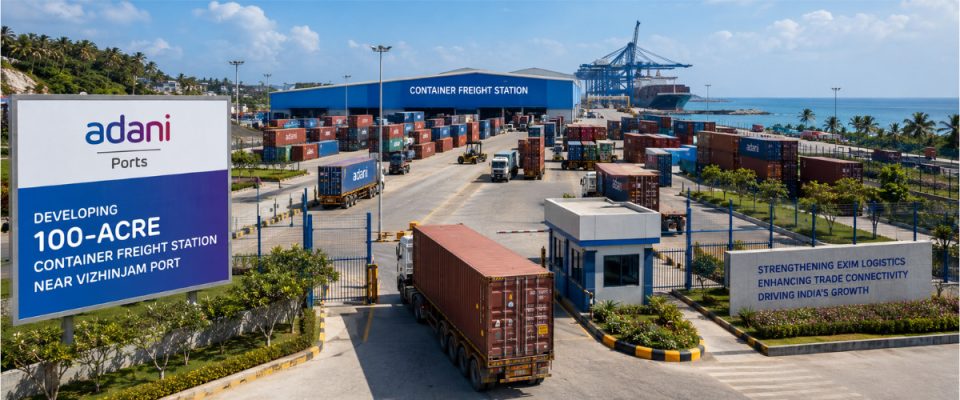
New logistics hub will enhance EXIM cargo handling, improve supply chain efficiency, and support growing container traffic at India’s first deep-water transshipment port.
Adani Ports and Special Economic Zone (APSEZ) is set to develop a 100-acre Container Freight Station (CFS) near Vizhinjam International Seaport in Kerala, strengthening logistics infrastructure for import-export (EXIM) cargo and supporting the rapid growth of India’s first deep-water transshipment port.
The proposed CFS will function as an integrated logistics hub, providing services such as container storage, customs clearance, cargo consolidation, deconsolidation, warehousing, and multimodal cargo handling. The facility is expected to streamline cargo movement between the port and inland destinations, reducing turnaround times and improving supply chain efficiency.
Located close to Vizhinjam Port, the freight station will play a key role in managing increasing container volumes as the port expands its operations. The additional logistics infrastructure is expected to ease congestion within the port, improve cargo evacuation, and strengthen connectivity for exporters and importers across southern India.
Vizhinjam has rapidly emerged as a strategic maritime gateway due to its natural deep draft and proximity to major international shipping routes. The port currently has a handling capacity of 1.6 million TEUs, with ongoing expansion expected to increase capacity to 5.7 million TEUs by 2028, positioning it as a major transshipment hub in the region.
The new Container Freight Station will complement APSEZ’s broader investments in port and logistics infrastructure, creating an integrated ecosystem that connects ports, inland logistics, warehousing, and multimodal transport. Such investments are expected to improve operational efficiency while supporting India’s ambition to become a global manufacturing and export hub.
With the development of the 100-acre CFS, Adani Ports aims to strengthen the logistics capabilities surrounding Vizhinjam Port, enabling faster cargo movement, enhancing trade competitiveness, and supporting long-term growth in India’s maritime and EXIM sectors.