

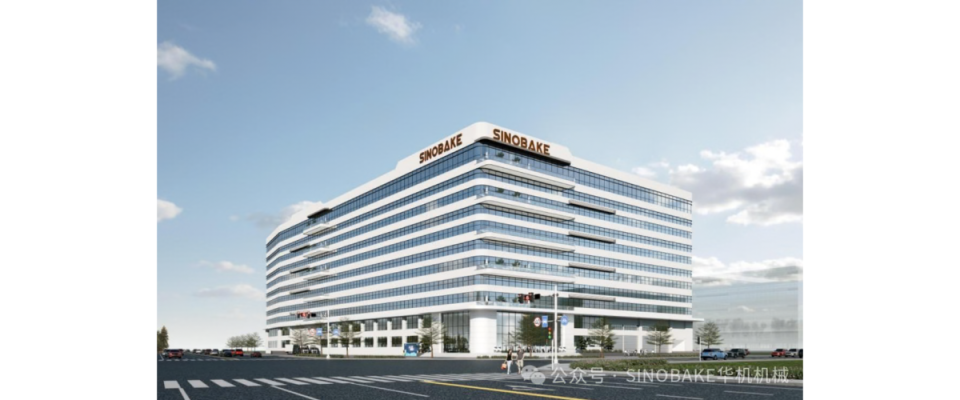
SINOBAKE is expanding its manufacturing infrastructure in Shunde, Guangdong, with a new industrial project designed to support the development and production of food processing lines and downstream automation equipment.
Guangdong Shunde Huaxin Technology Co., Ltd., a holding subsidiary of Guangdong Shunde Huaji Machinery Industrial Co., Ltd., successfully acquired an industrial land parcel in Beijiao, Shunde. The site covers approximately 24,004 square meters, with a planned total floor area of approximately 100,000 square meters. The project represents a planned total investment of approximately RMB 500 million, including no less than RMB 180 million in fixed-asset investment.
The planned facility will focus on the manufacturing and sales of new food production lines and downstream processing equipment, including packaging and palletizing systems. For the potato-processing and snack industry, the expansion extends SINOBAKE’s equipment scope beyond primary processing toward more integrated production and end-of-line automation.
From Potato Processing Equipment to Integrated Production Systems
Industrial potato snack production involves a series of interconnected processing operations. Depending on the product formulation and production technology, a compound or stackable potato chip line may include:
Raw Material Preparation → Dosing → Mixing → Sheeting → Forming → Frying or Cooking → De-oiling → Cooling → Seasoning → Packaging
The engineering objective is to maintain controlled material flow and stable operating conditions throughout the production line. A processing system therefore cannot be evaluated solely on the output of an individual machine. The capacity of the forming section, fryer, seasoning system, cooling conveyor and packaging equipment needs to be considered as part of a balanced production system.
This system-level approach is increasingly relevant as snack manufacturers seek higher levels of automation and reduced manual handling.
SINOBAKE’s Potato Chip Equipment Portfolio
SINOBAKE’s product portfolio includes equipment for compound and stackable potato chips, alongside biscuit and cookie production systems, automatic feeding equipment and silo dosing systems. Its potato chip solutions are designed around industrial production processes including mixing, forming, frying, cooling and seasoning. The company’s current PotatoPro product listings include SINOBAKE’s stackable potato chip production lines and related potato snack equipment.
For compound and stackable potato chips, process control is particularly important because product consistency depends on the relationship between formulation, dough properties, sheet thickness, forming conditions, frying or cooking conditions, cooling and seasoning. Equipment design therefore needs to consider the complete process rather than isolated machinery.
Growing Importance of Downstream Automation
As processing capacity increases, downstream handling becomes an increasingly important part of the overall production system. After potato snacks are processed and seasoned, finished products need to move through packaging and distribution operations. Depending on the production configuration, this may involve:
- Product conveying
- Inspection
- Weighing
- Primary packaging
- Secondary packaging
- Case handling
- Cartoning
- Palletizing
A high-capacity processing line can create a downstream bottleneck if packaging and material handling systems are not designed to maintain the required product flow. The integration of packaging and palletizing equipment is therefore becoming increasingly relevant to complete food-factory planning. The new SINOBAKE project is planned to support this broader equipment scope, adding greater emphasis on downstream processing and end-of-line automation.
Intelligent Control and Multi-Machine Connectivity
Another development direction for SINOBAKE is intelligent equipment control. The company is developing a cloud-based intelligent control system intended to support multi-machine connectivity, centralized equipment management, cloud computing and remote operation and maintenance.
In a modern food-processing plant, multiple machines operate as components of one production system. Connecting these machines can provide greater visibility into equipment status and production operations. The development direction can be represented as:
Machine Control → Line Control → Multi-Machine Connectivity → Data Visibility → Remote Operation and Maintenance
This approach is particularly relevant for large food-processing projects where production equipment, packaging systems and supporting machinery need to operate in coordination.
Manufacturing Capacity as Part of Equipment Engineering
For food machinery manufacturers, expanding manufacturing infrastructure is not only about increasing factory space. It can also support a wider range of engineering and production activities, including:
- Product development
- Mechanical manufacturing
- Electrical control integration
- Equipment assembly
- Production-line testing
- System integration
- Automation development
- Packaging and end-of-line equipment
For international food manufacturers, these capabilities are relevant when evaluating machinery suppliers for complete production projects. A supplier needs to understand not only how individual machines operate, but also how different sections of a production system interact.
News Courtesy : potato pro