

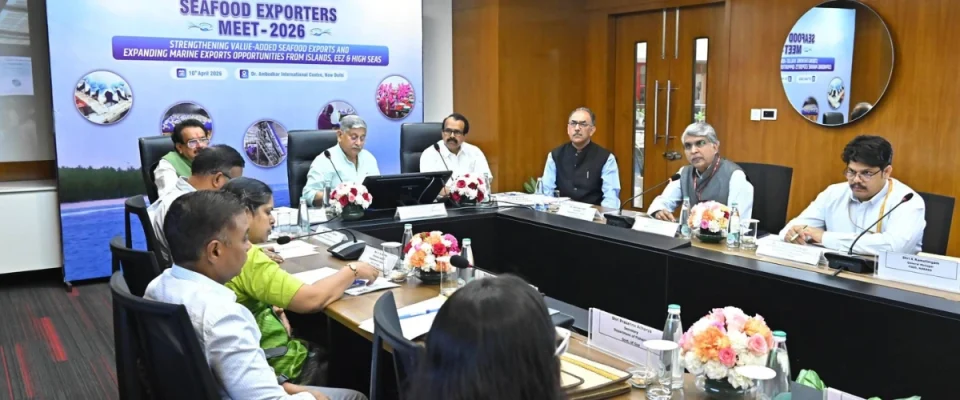
Union Minister Rajiv Ranjan Singh chaired the Seafood Exporters Meet 2026 in New Delhi, where a comprehensive strategy was outlined to expand India’s presence in global seafood markets and strengthen export performance.
The Minister emphasized increasing value-added seafood exports and tapping the full potential of India’s Exclusive Economic Zones (EEZs) and high seas. He also highlighted the need to upgrade infrastructure and develop better facilities to support exporters.
To improve competitiveness, the Minister urged the Marine Products Export Development Authority to enhance capacity-building programs. These initiatives aim to help exporters meet international standards, improve compliance, and boost export readiness.
Stakeholders raised several concerns, including simplifying the catch certification process, enabling permissions for seaweed cultivation in the Andaman and Nicobar Islands, and promoting scientific development of high-quality fish feed. Issues such as tariff and non-tariff barriers, rising costs, gaps in cold chain infrastructure, and the need for stronger quality assurance systems were also highlighted.
The meeting saw participation from major institutions, including the National Fisheries Development Board, NABARD, and the National Cooperative Development Corporation, along with representatives from various states.
India’s seafood exports have recorded an average annual growth of 7% over the past 11 years, rising from ₹30,213 crore in 2013–14 to ₹62,408 crore in 2024–25. Shrimp exports have been the primary driver of this growth.
India currently exports over 350 marine products to around 130 countries. The United States remains the largest market, accounting for 36.42% of total exports, followed by China, the European Union, Japan, and countries in the Middle East.