
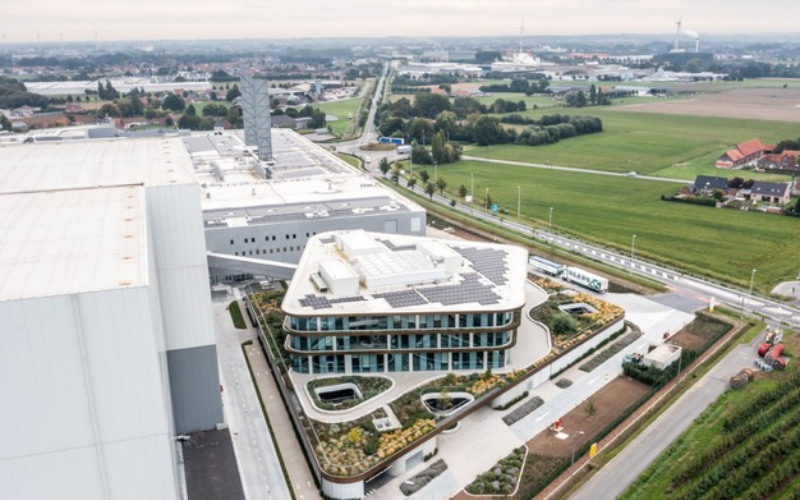
Three years ago, Agristo decided to double production at one of its Belgian sites. They are adding a new French fry production line, with room for further expansion, says Michaël Godaert, the company’s Civil Engineering Project Manager. Agristo is also building facilities in France, the US, and India. “We produce continuously per customer request,” he says.
“And we look for opportunities to make exactly what’s needed.” The existing production line will be mirrored to meet the world’s growing demand for frozen French fries. Along with that line, the project includes new potato receiving, shipping, packaging, and water treatment facilities. Planning is scheduled to the moment the factory becomes operational, to deliver products as soon as possible.
Lead time is vital
According to Michaël, the lead time is vital. Often, a building is completed first, and the production process is set up later, but at Agristo, that is done simultaneously wherever possible. That allows for earlier testing and means the factory can be operational sooner. “All the work is closely interlinked, so good communication and cooperation are essential. Two teams must function as one,” he says. Michaë adds that this approach is paying off: “I’ve never seen such a good turnaround time.”
Right products and contractors
Agristo wants its new building to still be the factory of the future in 30 years’ time. That requires the correct products and contractors. Walls, ceilings, and floors are finished in detail to ensure hygiene. Jean-Claude de Maaijer of the Ruys Groep explains that the connection between the wall and the floor is especially important.
“The building is 15 meters high. If the wall moves, a baseboard can crack, which causes problems for continuous production,” he says. The Ruys Groep developed a custom-made profile, mechanically attached to the floor, that can move independently of the wall. That ensures the wall-floor connection will stay in place, even three decades from now.
Collaboration between all involved – Agristo, the Ruys Groep, the architect, and contractor, Alheembouw – is, thus, essential. Michaël points out that they first had to identify technical possibilities, then weigh the pros, cons, and priorities before making well-founded decisions. “A perfect total solution is near impossible, but by working together, you can get optimal results,” he concludes.
Construction is largely complete, and finishing touches are being made to the production process. The site’s new capacity should be up and running in the summer of 2026. Once that happens, it will have four operational production lines.
With this expansion, Agristo responds to the growing global demand for frozen French fries and other potato products. Innovation, speed, hygiene, and close cooperation are key to successful delivery and a future-proof production facility.