


Introduction
Fish preservation is the process of extending the shelf life of fish and fishery products while maintaining their nutritional value, quality, and safety for human consumption. Since fish is highly perishable, preservation methods are essential to slow down spoilage, reduce waste, and ensure that fish remains fresh from the time it is harvested until it reaches consumers.
Proper handling immediately after catching the fish is the first step in preserving its quality. Cleaning, scaling, and gutting should be carried out as soon as possible to minimize deterioration and maintain freshness.
Causes of Fish Spoilage
Fish begins to deteriorate soon after it is harvested due to two major factors: bacterial activity and enzymatic reactions.
Bacterial Spoilage
Bacteria naturally exist on the skin, gills, and internal organs of fish. After the fish dies, these microorganisms begin multiplying and break down the flesh, causing unpleasant odors, slime formation, and spoilage.
During the early post-harvest stage, fish enters a condition known as rigor mortis. At this stage, lactic acid accumulates in the muscles, creating an acidic environment that temporarily slows bacterial growth. Once rigor mortis ends, bacteria multiply rapidly, leading to faster decomposition.
Enzymatic (Autolytic) Spoilage
Fish also contains natural digestive enzymes that continue to function after death. These enzymes gradually break down muscle tissues, causing the flesh to soften. As decomposition progresses, compounds such as hydrogen sulfide are produced, resulting in undesirable odors.
Several factors accelerate fish spoilage, including:
- High storage temperatures
- Delays in transportation
- Poor gutting and cleaning practices
- Unhygienic handling
- Dirty or contaminated packaging materials
Maintaining proper hygiene and temperature control is therefore essential for preserving fish quality.
Major Methods of Fish Preservation
Several preservation techniques are used worldwide to extend the storage life of fish. The most common methods include freezing, sun drying, salt drying, brining, smoking, canning, and pickling. Among these, freezing, drying, and salting remain the most widely practiced.
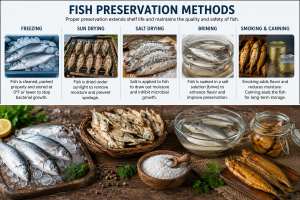
1. Freezing
Freezing is one of the most effective methods for preserving fish because it significantly slows bacterial growth and enzyme activity.
To obtain high-quality frozen fish:
- Handle fish carefully immediately after harvesting to prevent physical damage.
- Remove the guts and wash the fish thoroughly.
- Wrap the fish in airtight packaging to prevent freezer burn and preserve flavor.
- Store fish at 0°F (-18°C) or lower.
Freezing Methods
Ice Storage
One traditional approach involves placing a layer of ice at the bottom of a container, arranging the fish over the ice, and covering it with another layer of ice. The gradual cooling helps preserve the fish’s texture, freshness, and natural taste.
Deep Freezing
Commercial processors often use deep freezers to store whole fish, steaks, or fillets at very low temperatures. This method allows long-term storage while maintaining product quality.
2. Sun Drying
Sun drying is one of the oldest fish preservation techniques and is particularly suitable in regions with high temperatures and low humidity.
The method works by removing moisture from the fish, making conditions unfavorable for bacterial growth.
Straight Sun Drying
Freshly cleaned fish are spread on drying surfaces such as:
- Mats
- Raised platforms
- Rooftops
- Rocks
- Sea sand
Exposure to direct sunlight removes moisture naturally until the fish is adequately dried.
Improved Sun Drying
Improved sun drying combines drying with additional preservation techniques such as salting. Salt inhibits microbial growth while drying removes moisture, producing a safer and longer-lasting product.
3. Salt Drying
Salt drying combines partial drying with salt treatment to extend the shelf life of fish.
The process involves:
- Scaling and gutting the fish.
- Partially drying the fish.
- Applying salt inside the body cavity and over the outer surface.
- Allowing the fish to drain for one to three days so the salt penetrates the flesh.
Salt removes moisture from the fish tissues through osmosis and creates conditions that prevent the growth of spoilage microorganisms.
4. Brining
Brining is the process of soaking fish in a prepared salt solution before drying or further processing.
During brining, salt gradually penetrates the muscle tissue, improving preservation while enhancing flavor and texture.
Typically, fish are immersed in the brine for approximately one hour before being transferred for sun drying.
Steps in Brining Fish
- Measure the correct quantity of salt and dissolve it completely in clean water.
- Prepare enough brine to fully immerse the fish.
- Soak the fish for at least one hour to allow uniform salt absorption.
- Maintain the brine temperature below 40°F (4.4°C) to minimize bacterial growth.
- Brine fish of similar size together to ensure even penetration.
- After brining, transfer the fish for drying to further reduce moisture and improve storage life.
Proper brining helps reduce microbial activity while producing fish with improved taste, texture, and shelf stability.
Other Fish Preservation Methods
Besides freezing, drying, and salting, fish can also be preserved through:
- Smoking, where smoke and heat remove moisture while adding flavor.
- Canning, which seals cooked fish in airtight containers to achieve long-term storage.
- Pickling, where fish is preserved in vinegar, salt, and spices, creating an acidic environment that inhibits bacterial growth.
Conclusion
Fish preservation is essential for maintaining product quality, reducing post-harvest losses, and ensuring food safety. Because fish spoils rapidly due to bacterial activity and natural enzymatic processes, proper handling immediately after harvest is critical. Preservation techniques such as freezing, sun drying, salt drying, brining, smoking, canning, and pickling effectively extend shelf life while retaining the fish’s nutritional value and market quality. Selecting the appropriate preservation method depends on available resources, climate conditions, and intended storage duration. By following good hygiene practices and applying suitable preservation techniques, producers and consumers can minimize food waste and enjoy safe, high-quality fish throughout the year.