

India’s expanding network of free trade agreements can help food processors, seafood exporters and agri-food MSMEs access new international markets, improve competitiveness and increase value-added exports.
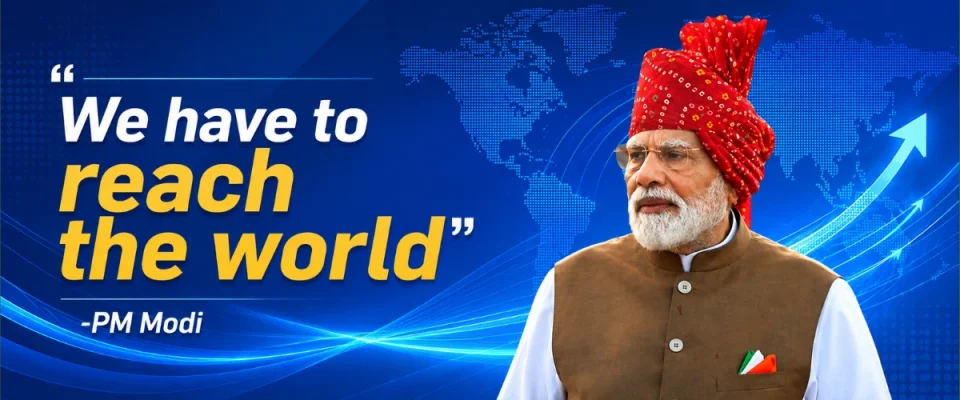
Prime Minister Narendra Modi has urged India’s micro, small and medium enterprises (MSMEs) to make greater use of the country’s expanding Free Trade Agreements (FTAs) to take Indian products into global markets. For the food and seafood sectors, the approach could create new opportunities for exporters of processed foods, agricultural products, marine products and value-added seafood.
India’s food and agricultural exports, including fisheries and marine products, already represent a major export opportunity. Commerce Minister Piyush Goyal has said India’s food and agricultural exports are worth nearly ₹5 lakh crore annually, while the country is seeking to become the world’s largest exporter of agricultural and processed foods.
For seafood exporters, greater use of FTAs can improve access to overseas markets by reducing tariffs and creating more predictable trading conditions. This is particularly relevant for India’s shrimp, fish and other marine-product exporters seeking to expand beyond established destinations and strengthen their position in global seafood supply chains.
The opportunity extends beyond raw and frozen products. Food-processing MSMEs can use preferential market access to expand exports of ready-to-eat foods, processed fruits and vegetables, spices, packaged foods, frozen foods, dairy products and other value-added products. This would encourage manufacturers to move further up the value chain rather than exporting primarily agricultural commodities.
Government initiatives are also being developed to help MSMEs actually utilise FTAs. These include export facilitation centres, sector-specific export promotion, buyer-seller programmes, overseas trade missions and the Districts as Export Hubs initiative. The government has established 65 Export Facilitation Centres through the Ministry of MSME to provide mentoring and handholding for exporters.
For seafood businesses, market access alone is not sufficient. Exporters must also meet food safety, sanitary and phytosanitary requirements, traceability, quality standards and cold-chain requirements in destination markets. India has been working to address these non-tariff barriers alongside its FTA strategy.
The FTA push could therefore benefit the wider food and seafood value chain, including farmers, aquaculture producers, seafood processors, cold-chain operators, packaging companies, logistics providers and export-oriented MSMEs. Better market access can support larger orders and encourage investment in processing and export infrastructure.
India’s seafood sector is already demonstrating strong export potential. In FY2025–26, India’s seafood exports reached a record 19.72 lakh tonnes valued at ₹73,890.46 crore, highlighting the scale of the opportunity for further international expansion.
The Prime Minister’s call to leverage FTAs ultimately places greater emphasis on export readiness among Indian MSMEs. For food and seafood businesses, combining preferential trade access with quality, processing, certification, branding and reliable supply chains could help Indian products gain a stronger position in international markets.