

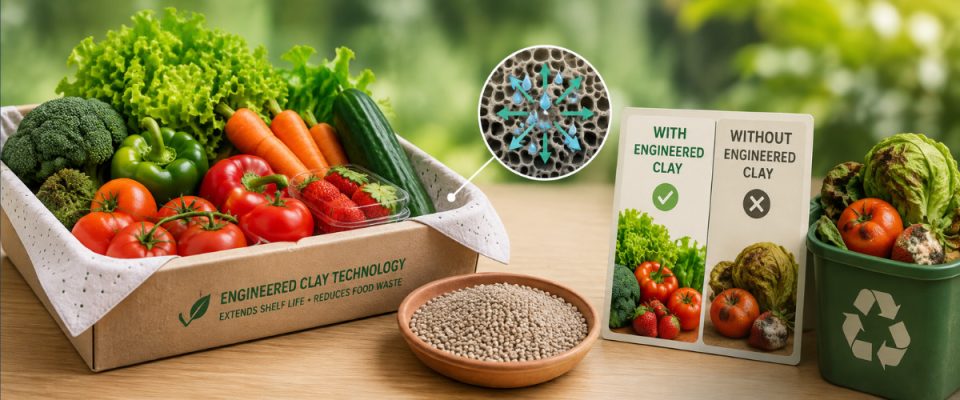
Researchers have developed an innovative clay-based material that captures ethylene gas, slowing fruit and vegetable ripening to reduce spoilage, improve produce quality, and support more sustainable food supply chains.
Scientists have developed an innovative clay-based material that could significantly extend the shelf life of fresh fruits and vegetables, offering a promising solution to one of the world’s biggest food sustainability challenges. The breakthrough technology works by capturing ethylene gas—a natural plant hormone responsible for accelerating the ripening process—thereby slowing spoilage during storage and transportation.
The research, led by a team at the University of Copenhagen in collaboration with Lawrence Berkeley National Laboratory, focuses on modifying the naturally occurring clay mineral montmorillonite. While the mineral already possesses gas-absorbing properties, researchers enhanced its internal structure through chemical treatment, allowing it to capture and retain significantly higher amounts of ethylene.
Ethylene is naturally released by many fruits and vegetables, including bananas, tomatoes, avocados, and apples. During storage and long-distance transportation, the gas accumulates inside sealed containers and packaging, causing produce to ripen more quickly. This accelerated ripening often leads to large quantities of food being discarded before reaching retailers or consumers.
By removing excess ethylene from the surrounding environment, the engineered clay helps maintain freshness for a longer period. Researchers suggest the material could be incorporated into small sachets, packaging inserts, or transport containers, making it a practical and cost-effective addition to existing food packaging systems without requiring major infrastructure changes.
Beyond reducing food waste, the innovation could also improve fruit quality. Since many fruits are harvested before reaching full ripeness to withstand long shipping times, extending shelf life would allow growers to harvest produce closer to its natural maturity. This could enhance flavour, aroma, and overall eating quality while reducing economic losses across the supply chain.
The researchers believe the technology has applications beyond food preservation, as the modified clay’s ability to selectively capture gases may prove valuable in other industrial and environmental processes. Further studies will focus on scaling the technology for commercial packaging and evaluating its performance under real-world storage and distribution conditions.
With food waste remaining a major global concern, innovations such as engineered clay packaging could play an important role in improving supply chain efficiency, supporting sustainability goals, and ensuring more fresh produce reaches consumers in optimal condition.