

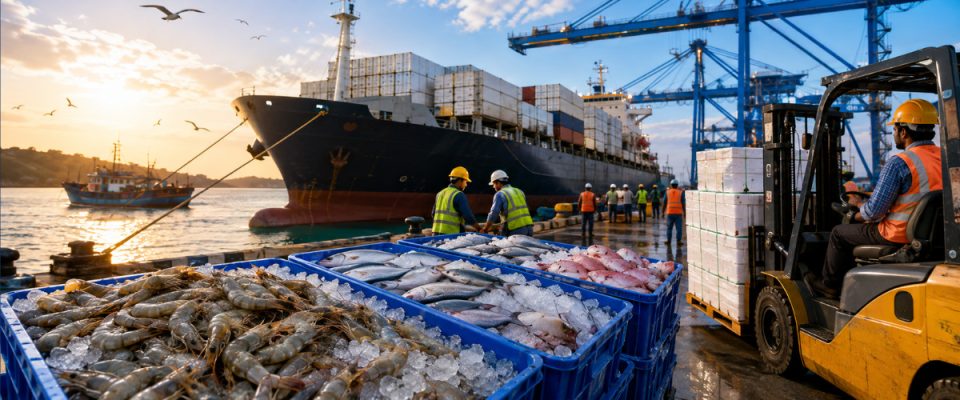
Visakhapatnam Port strengthens its position as India’s leading seafood gateway, handling nearly half of the country’s marine export trade in FY2025–26.
Visakhapatnam Port has emerged as India’s leading gateway for seafood exports, maintaining a dominant position despite challenging global trade conditions. The port handled 3.28 lakh tonnes of seafood worth ₹20,217 crore in FY2025–26, highlighting its critical role in India’s expanding marine export ecosystem.
India’s overall seafood exports reached a record 19.72 lakh tonnes valued at ₹73,890.46 crore (US$8.46 billion) during FY2025–26. Against this backdrop, Visakhapatnam Port remained the country’s top seafood-exporting gateway, supported by strong aquaculture production in Andhra Pradesh and efficient port infrastructure.
The port’s significance has also increased sharply over recent years. According to data presented by the Union government, Visakhapatnam accounted for 50.87% of India’s marine-product exports in FY2024–25 and 48.89% in FY2025–26. This places Vizag well ahead of other major seafood gateways in India’s export network.
A major contributor to the port’s performance is Andhra Pradesh’s large aquaculture and shrimp-farming ecosystem. Frozen shrimp continues to be India’s leading seafood export category, and the concentration of shrimp production and processing in the region provides Visakhapatnam with a strong and consistent cargo base.
The port’s infrastructure is another important factor. Efficient cargo handling, refrigerated container operations and connectivity to international markets enable exporters to move temperature-sensitive seafood products while maintaining quality throughout the logistics chain. Visakhapatnam was also India’s leading seafood export port by value in FY2025–26, with marine cargo worth about US$2.32 billion.
Visakhapatnam Port’s broader operational performance has also strengthened. In FY2025–26, it handled a record 91.17 million tonnes of total cargo, the highest throughput in its 92-year history, reflecting improvements in vessel handling, turnaround times and overall operational efficiency.
The port’s growth is closely linked to the wider development of India’s seafood processing, aquaculture and cold-chain sectors. With frozen shrimp, fish and other marine products forming a major part of the country’s export basket, efficient maritime logistics are increasingly important for maintaining India’s competitiveness in international seafood markets.
With nearly half of India’s marine exports moving through Visakhapatnam, the port has become a vital link between Andhra Pradesh’s aquaculture industry and global seafood markets. Its continued infrastructure and logistics development could further strengthen the region’s position as a major hub for seafood processing, exports and international trade.