

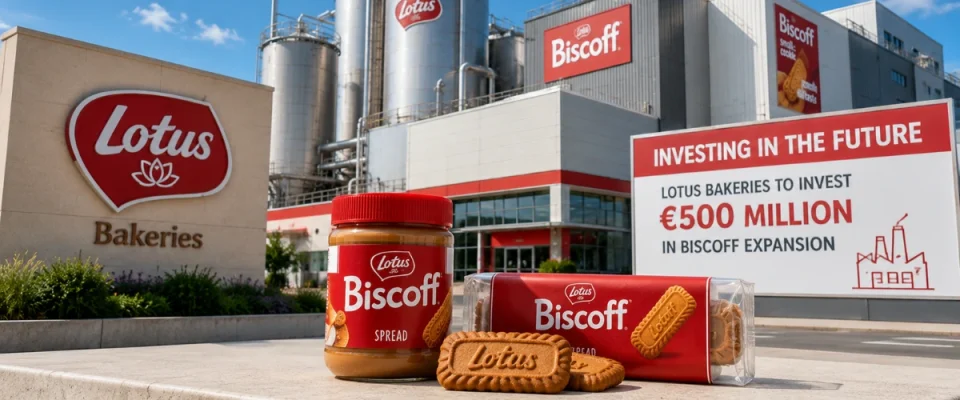
The company will expand Biscoff production in Belgium, the US and Thailand to meet growing global demand between 2026 and 2030.
Lotus Bakeries has announced plans to invest at least €500 million (about US$578 million) in expanding its Biscoff production capacity across three continents between 2026 and 2030. The investment represents the company’s largest-ever expansion programme for the Biscoff brand and is aimed at meeting rising demand across Europe and the Middle East, the Americas, and Asia-Pacific.
The investment will cover production facilities in Belgium, the United States and Thailand. In the US, Lotus Bakeries will construct a new building at its Mebane, North Carolina facility, with commissioning expected in mid-2028 and additional capacity planned for 2029. The site has already undergone several expansions since its establishment.
In Thailand, the company plans to add a second production hall and introduce additional production capacity at its Chonburi facility. The new production is expected to become operational before the end of 2027, strengthening Lotus Bakeries’ ability to serve the rapidly expanding Asia-Pacific market from a regional manufacturing base.
The programme also includes a new production hall at the company’s Lembeke facility in Belgium, its long-established Biscoff manufacturing base. Together, the three investments are designed to create additional capacity closer to key consumer markets while supporting the company’s international growth strategy.
The expansion comes as Biscoff continues to record strong growth. During the first half of 2026, Lotus Bakeries reported €749.09 million in revenue, up 14% year-on-year, while Biscoff volume and revenue increased by more than 20%. In the US, Biscoff was the company’s fastest-growing brand across both cookies and spreads, with household penetration of the cookie exceeding 10%.
Lotus Bakeries said the investment will support its ambition to build Biscoff into the world’s third-largest cookie brand. By expanding manufacturing capacity across three strategic regions, the company aims to respond more efficiently to international demand while strengthening its global supply network.
The €500 million programme highlights the continued growth of the global biscuit and snack-food market and demonstrates how food manufacturers are investing in large-scale production infrastructure to support rapidly expanding consumer brands.